- What
- Final project for the advertising creativity lab — June 10, 2025
- Who
- A team of five: Carlotta Bacilieri, Sara Castronuovo, Annalisa Murasco, Antonio Pecora, Angelica Salerno
- Deliverables
- Insight, concept, commercial storyboard, six billboards and tagline
- Client
- Amnesty International — client selected for the final project
How the campaign came together
The exam required us to show «every step in the development of the campaign, from planning and identifying the insight to developing the idea and producing the final creative execution». The process mattered just as much as the final result, so this page follows the same order: brief, insight, concept, execution, billboards.
The insight
Many people support the death penalty until they have to look it in the eye.
So why a campaign like this in Italy, where there is no one to save from death row? The death penalty has been excluded from the civilian legal system since 1947 and from the military criminal code since 1994, but support for bringing it back is not marginal: in February 2024, SWG’s Radar found that 31% of Italians supported its reintroduction, compared with 57% who opposed it and 12% who preferred not to answer1.
But the numbers change significantly depending on how the question is asked. In December 2020, the 54th Censis Report found 43.7% in favour when asking about the death penalty «for those who commit particularly heinous crimes»; among 18–34-year-olds, the figure rose to 44.7%2. The 2022 Eurispes Italy Report, which simply asked about reintroducing the death penalty, found 15.8% in favour3. That is a gap of almost 28 percentage points between the two formulations.
This is where we found the starting point for the campaign: in the difference between saying you support the death penalty and confronting what that actually means.
The death penalty is easy to support when it remains distant and abstract, without a face. But that changes when the distance closes and you are faced with its reality: a person, an irreversible sentence, the possibility of a wrongful conviction.
That distance therefore becomes the thread running through the campaign. It lies at the heart of the tagline and comes back in the way we built the billboards: bringing something that normally remains distant and abstract as close as possible to the person looking at it.
The concept
With the death penalty, it’s not just a person who dies. The possibility of correcting a mistake dies too.
The concept doesn’t argue whether the death penalty is right or wrong: it shifts the focus to the possibility of error. What happens when the conviction is wrong? A prison sentence can be overturned, a conviction can be reversed. With the death penalty, that possibility disappears: once the sentence is carried out, there is no going back.
The concept therefore doesn’t necessarily ask people to change their mind about the death penalty, but to confront a consequence that cannot be undone.
The billboards
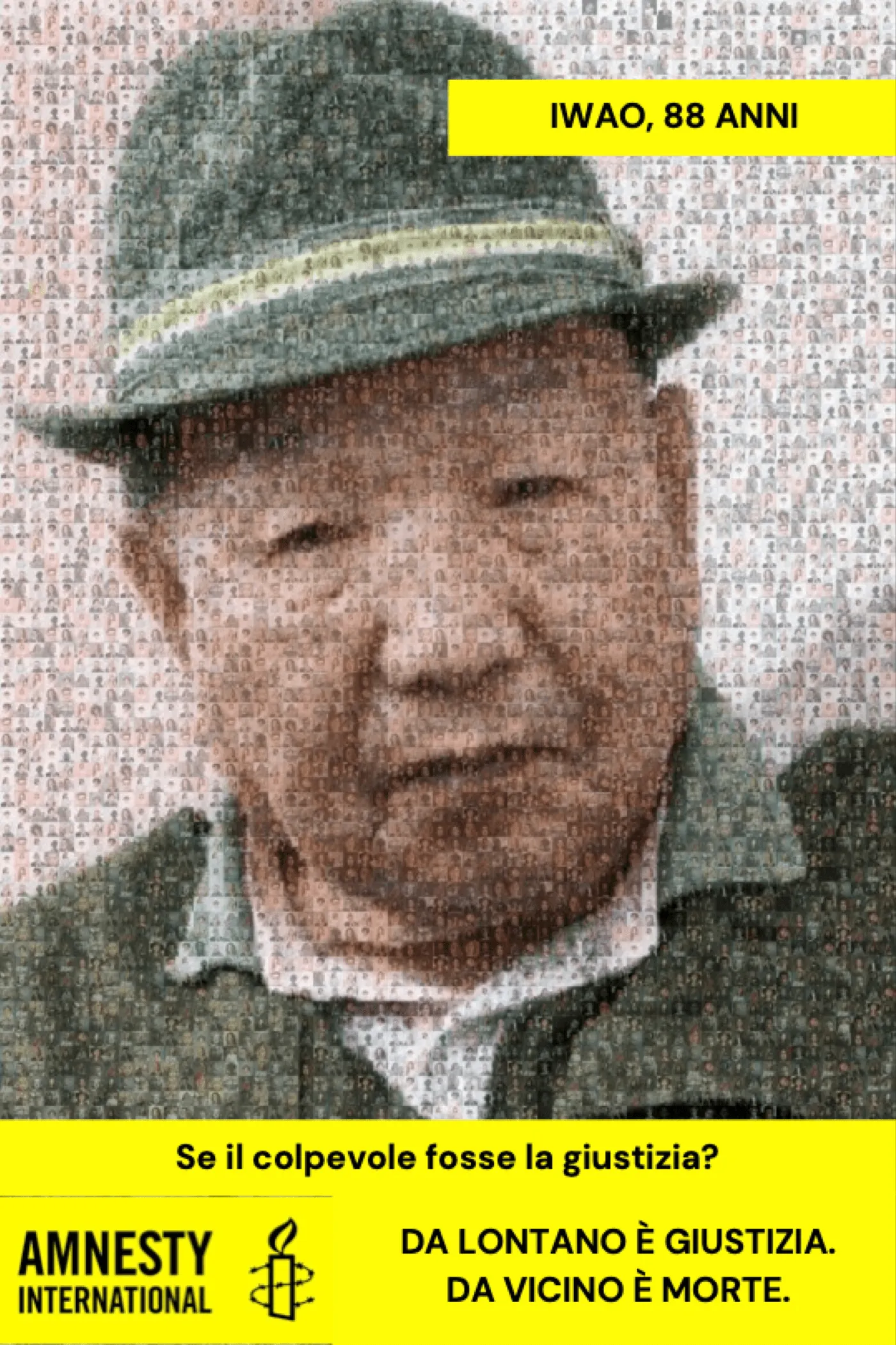
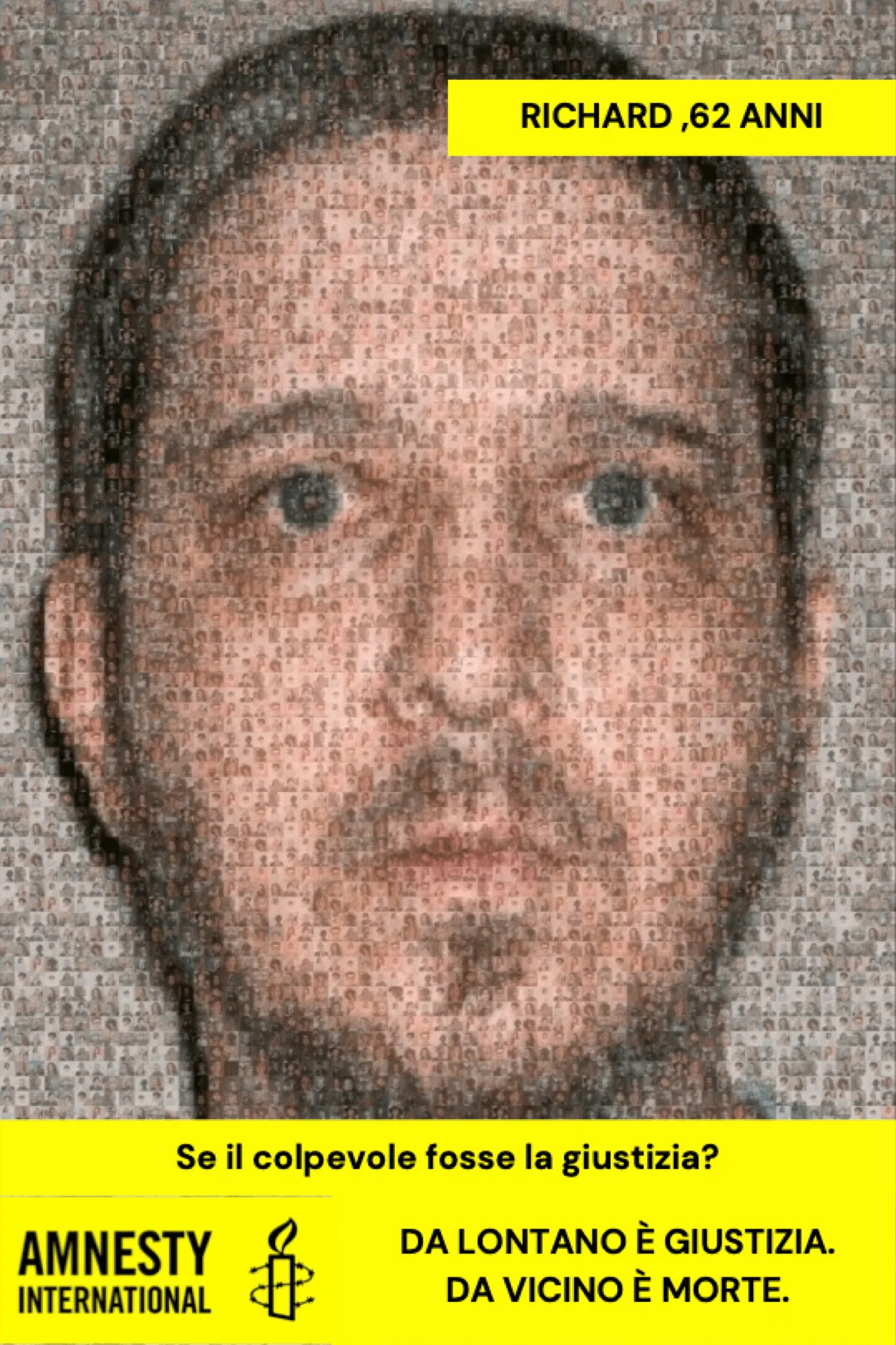
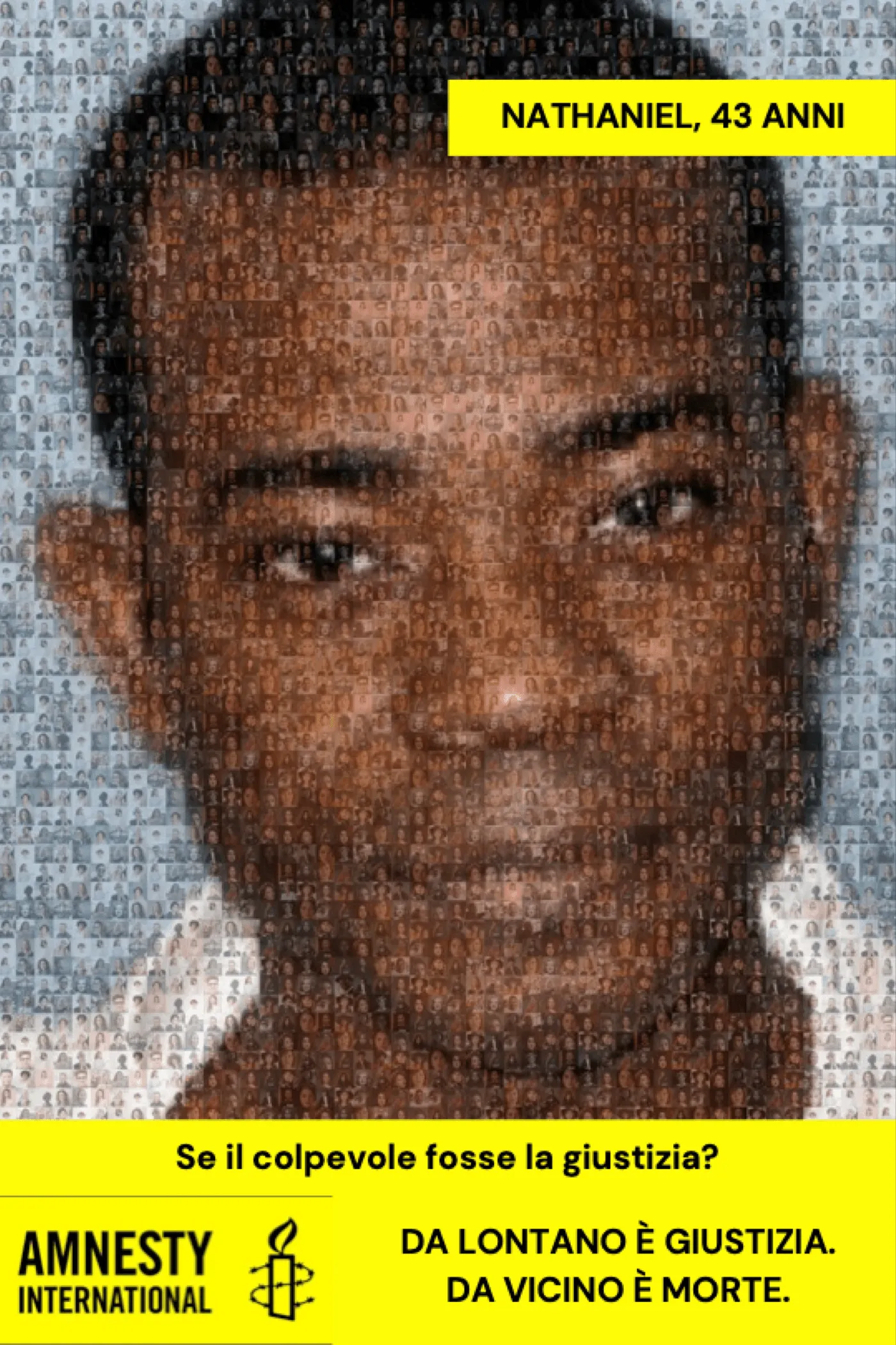
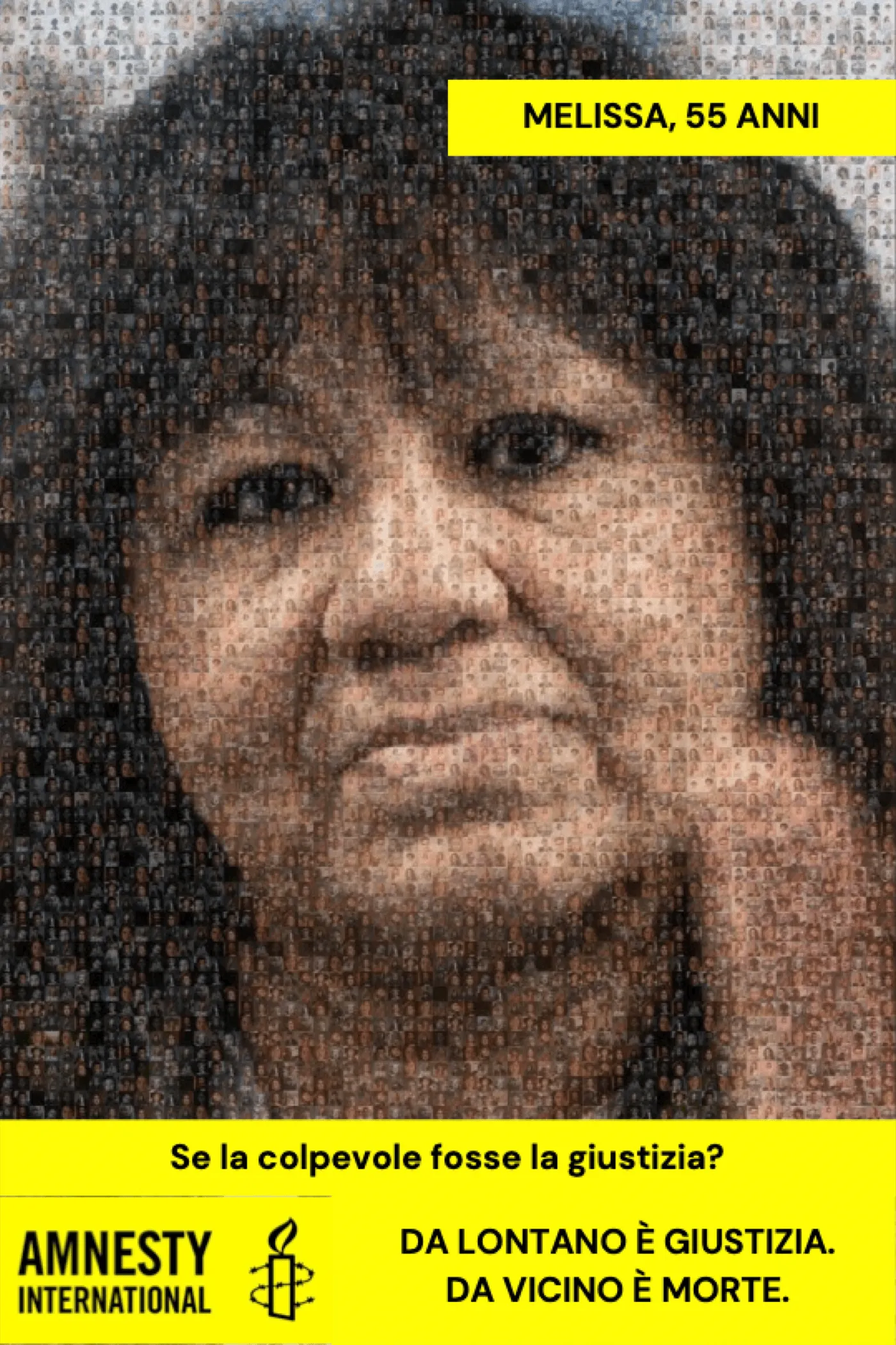
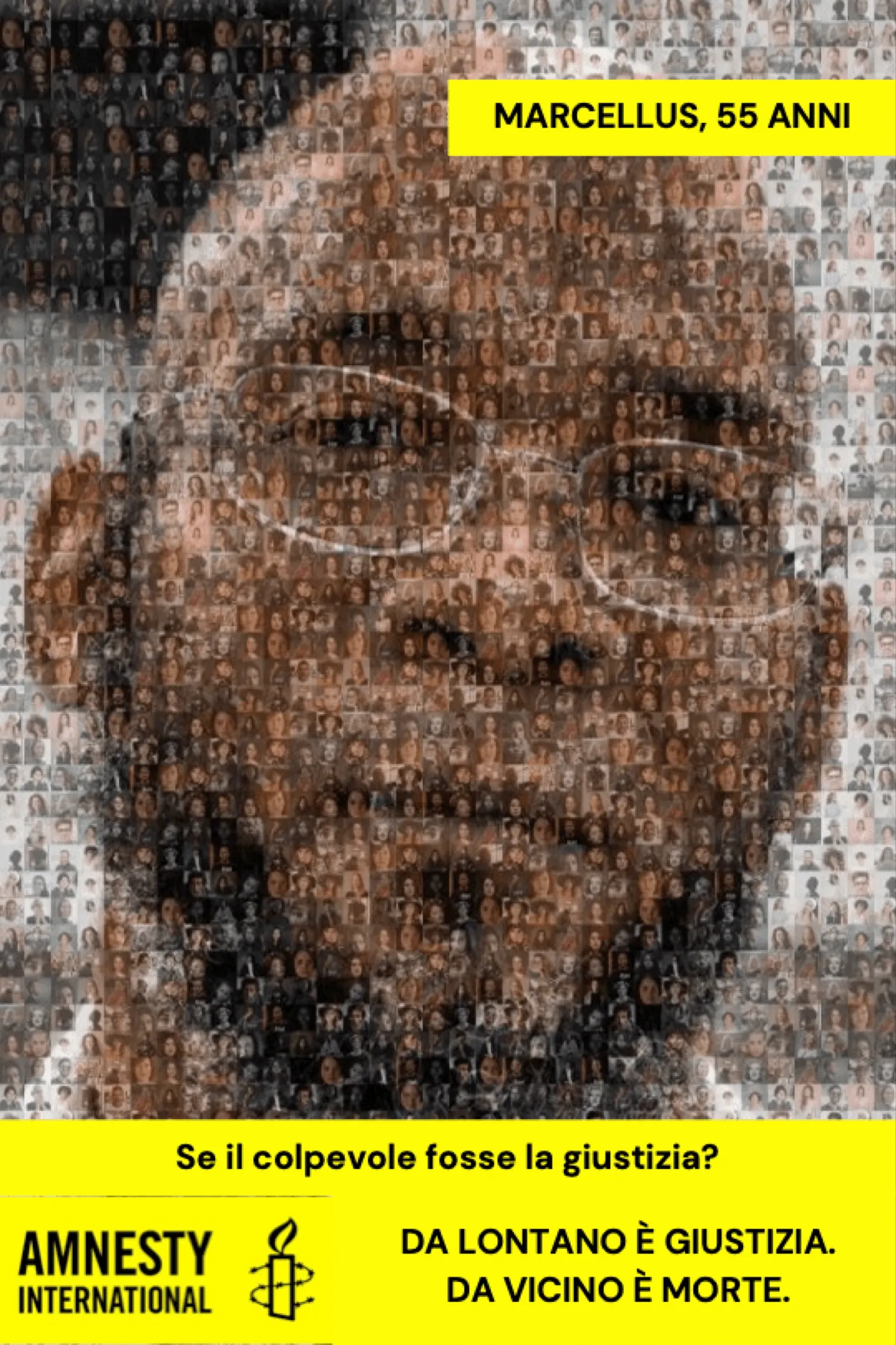
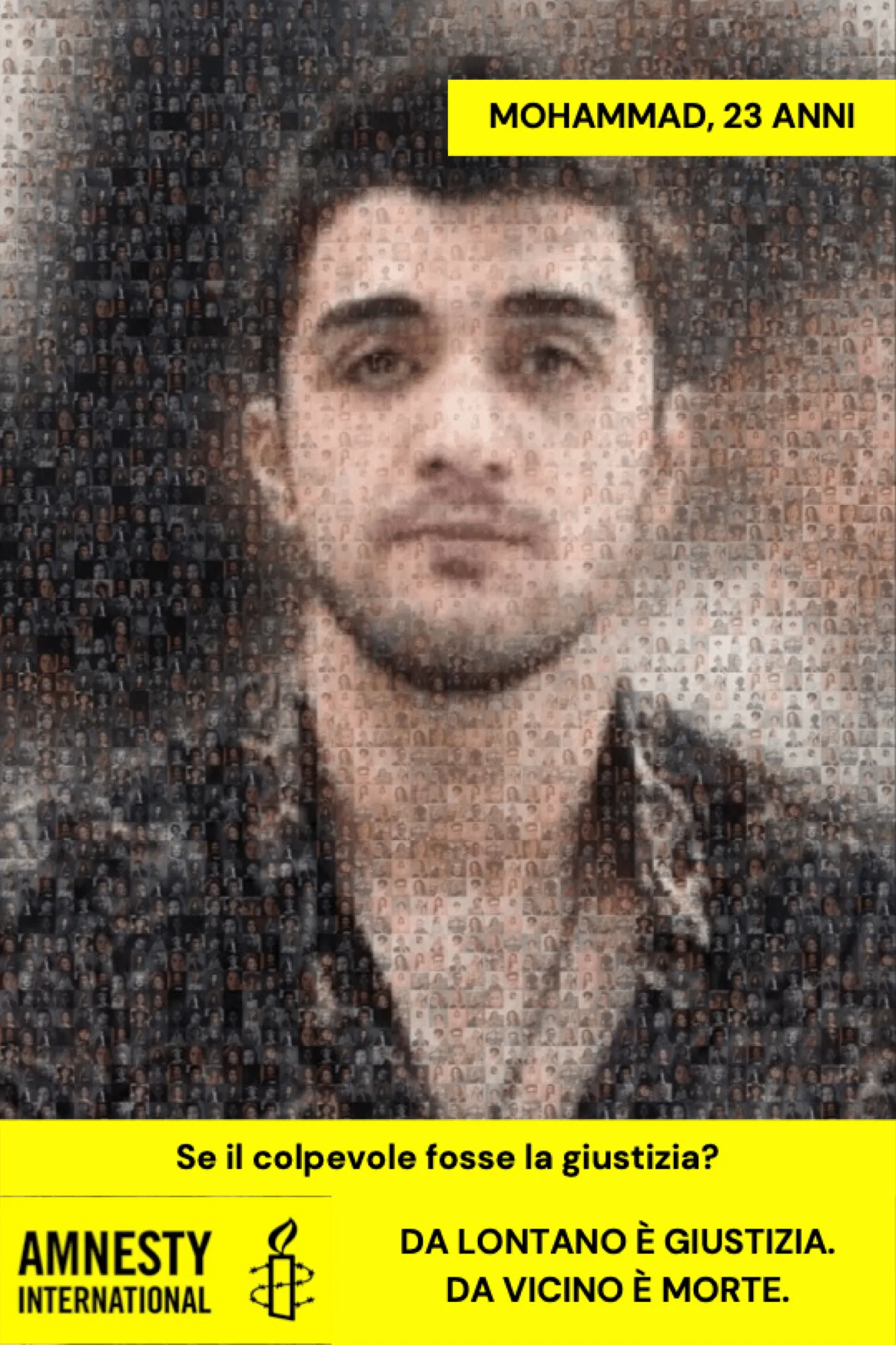
Each billboard shows the face of a person sentenced to death, made up of hundreds of other faces arranged into a mosaic. From a distance, you see one person. As you get closer, you see the people they are made of.
The tagline is «Justice from a distance. Death up close.»
What isn’t written
None of the six billboards says «innocent» next to the person’s face. This is not an oversight.
The concept focuses on wrongful convictions — on the very real possibility that an innocent person could be executed — but the headline opens up a broader question: «What if justice were the guilty one?» A person may be guilty; the point is that no one has the right to take their life, not even a court.
The six people featured on the billboards are real; the crowd making up their faces is not. The mosaic faces come from a photo archive, because these billboards were created to represent an idea. In production, they would have used the faces of people who had actually been sentenced to death.
Here are the six people and the status of their cases as of September 28, 2026.
| On the billboard | Who they are | What we know |
|---|---|---|
| Iwao, 88 | Iwao Hakamada, Japan | Acquitted on September 26, 2024, after 46 years on death row: the evidence used to convict him had been planted4 |
| Richard, 62 | Richard Glossip, Oklahoma | Conviction overturned by the U.S. Supreme Court on February 25, 2025, because the prosecution’s key witness had lied in court and prosecutors who knew about it failed to correct the testimony. Out on bail since May 14, 2026, awaiting a new trial5 |
| Melissa, 55 | Melissa Lucio, Texas | Declared «actually innocent» by a judge in 2024. On September 24, 2026, the Texas appeals court rejected that ruling, 5 votes to 4: she remains on death row. Her lawyers will take the case to federal court6 |
| Marcellus, 55 | Marcellus Williams, Missouri | Executed on September 24, 2024, despite the prosecutor and the victim’s family asking for the execution to be stopped7 |
| Nathaniel, 43 | Nathaniel Woods, Alabama | Executed on March 5, 2020. He did not fire the shots: he was convicted as an accomplice by a non-unanimous jury8 |
| Mohammad, 23 | Mohammad Ghobadlou, Iran | Executed on January 23, 2024, after a trial without a lawyer. He had bipolar disorder9 |
Three of the six were executed.
The commercial
The commercial runs for forty-five seconds and is divided into five blocks.
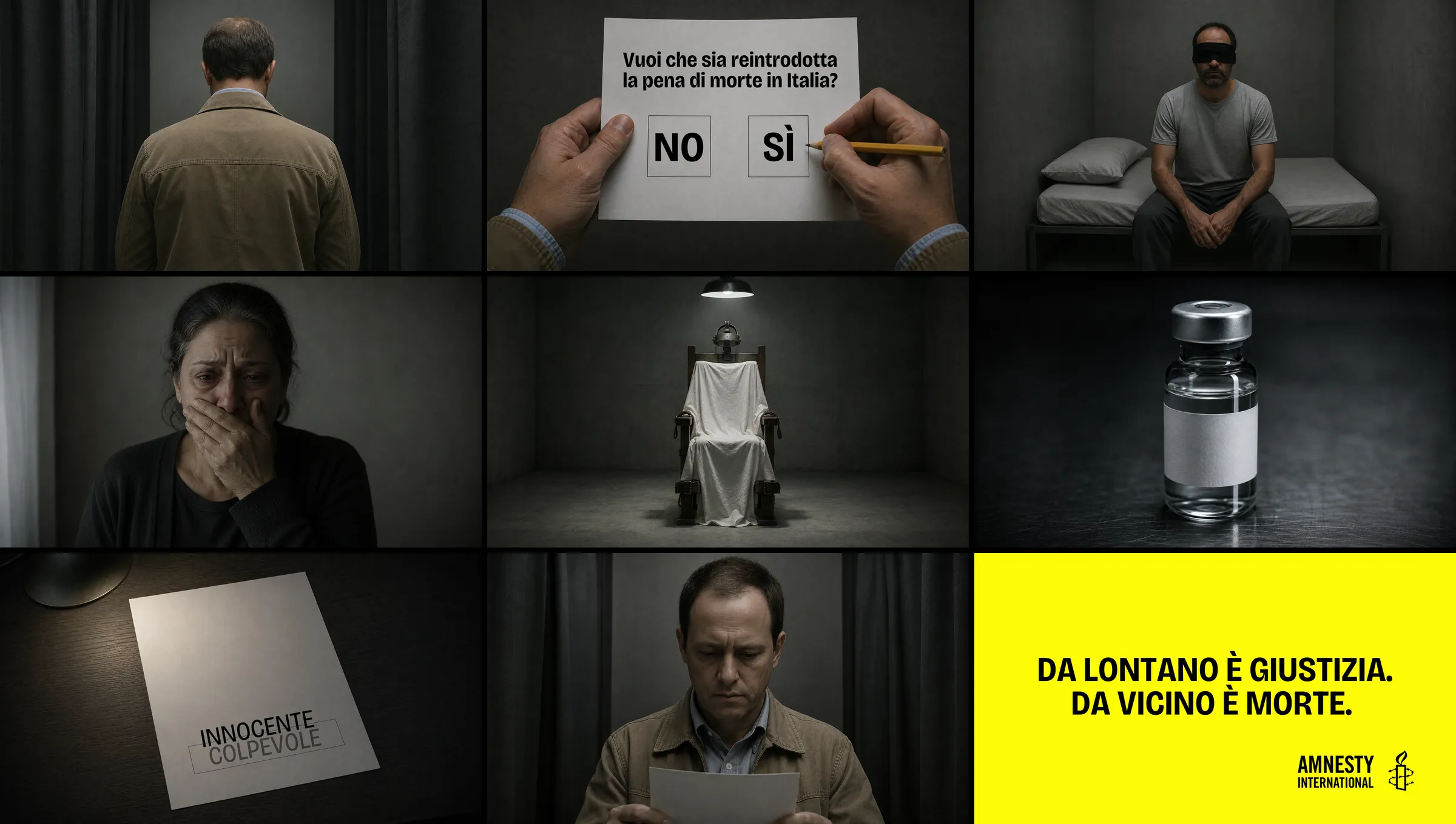
0:00 – 0:05. A man in his forties enters a voting booth. He is holding a ballot with a question: «Do you want the death penalty to be reintroduced in Italy?», followed by two boxes, YES and NO. He is about to mark YES.
0:06 – 0:20. The camera stays on his fingers holding the pencil. Just as he is about to make his choice, a series of quick images begins to flash by, like thoughts running through his mind: a blindfolded man in a cell, a mother receiving devastating news, an electric chair covered by a white sheet, a lethal injection vial, a sentence changing from «Guilty» to «Innocent», a torn family photograph, a clock suddenly stopping.
The images are accompanied by muffled sounds and distant voices: «But he was innocent…», «There’s no going back…»
0:21 – 0:30. We return to the voting booth. The man looks at the ballot, stays silent and sighs. Then he changes his mind and marks NO. He leaves the booth.
0:31 – 0:40. Only then does the male voice-over come in, calm and authoritative: «Every vote counts. But when it comes to someone’s life… there’s no going back.»
0:41 – 0:45. The Amnesty International logo and the tagline «Justice from a distance. Death up close.» remain alone on screen for five seconds.
Why it works this way
The commercial doesn’t have anyone trying to convince the man. The voice-over comes after he has made his choice. First, we see him about to vote YES. Then the montage shows him what that choice actually means. Finally, we return to the booth to see what he decides.
The movement is therefore very simple: YES → confrontation with reality → NO.
This is also how the commercial translates the insight. For fourteen seconds, the man remains still inside the booth while the montage brings him closer to what he is about to choose.
It follows the same principle as the billboard, but in reverse. With the billboard, you physically move closer to the face and discover what it is made of. In the commercial, you stay still while the images bring you closer.
In both cases, the distance being closed is the one at the heart of the insight: from a distance, the death penalty is an opinion you can express in a survey; up close, it is the reality behind that opinion.
Footnotes
-
Fanpage — Un italiano su tre vuole reintrodurre la pena di morte, reporting SWG’s Radar survey, February 2024. In Italian. ↩
-
TPI — Censis: quasi la metà degli italiani è favorevole alla pena di morte, on the 54th Censis report on the social situation of the country, 4 December 2020. In Italian. ↩
-
Eurispes — Italy Report 2022, findings: “84.2% of Italians are not in favour of the reinstatement of capital punishment in our legal system”. ↩
-
Death Penalty Information Center — Citing Misconduct, Japanese Court Formally Exonerates Iwao Hakamada. ↩
-
NBC News — Supreme Court throws out Oklahoma death row inmate’s conviction over flawed trial. On his release on bail: Death Penalty Information Center — Richard Glossip, Released on Bail Pending Retrial. The retrial, without the death penalty, is set for December 9, 2026: News 9 — Richard Glossip retrial pushed back until December. ↩
-
Innocence Project — Sharply Divided Texas Court of Criminal Appeals Rejects Trial Court’s Finding of Constitutional Error, September 24, 2026. ↩
-
Innocence Project — Marcellus Williams. His conviction was never overturned. ↩
-
Equal Justice Initiative — Nathaniel Woods Execution Reveals Disturbing Bias in Alabama. ↩
-
Amnesty International — Iran: Executions of protester with mental disability and Kurdish man mark plunge into new realms of cruelty. ↩