Nothing happens by chance — or so they say.
Whether I meant to or not, I spent a semester in Korea — if you’ve already gotten bored reading a little something about me, you already know that — and one of the courses I took was called Journalism Reading and Writing. From the name, you’d think it was a writing course. In reality, it was all about video, and the only piece of equipment we needed was a smartphone.
Every assignment started with an idea, went through the script, and ended with a video.
So, what you’re about to see are pieces of the Seoul I carry in my heart. I came up with them, wrote them, shot them, and edited them myself. Don’t expect Scorsese-level directing, but there was a whole lot of effort, a whole lot of wanting to do a good job, and love — which, as my mum always says, is the secret ingredient to doing anything well.
1. Hugging Harmonies
Five-shot sequence · 42 seconds · watch on YouTube
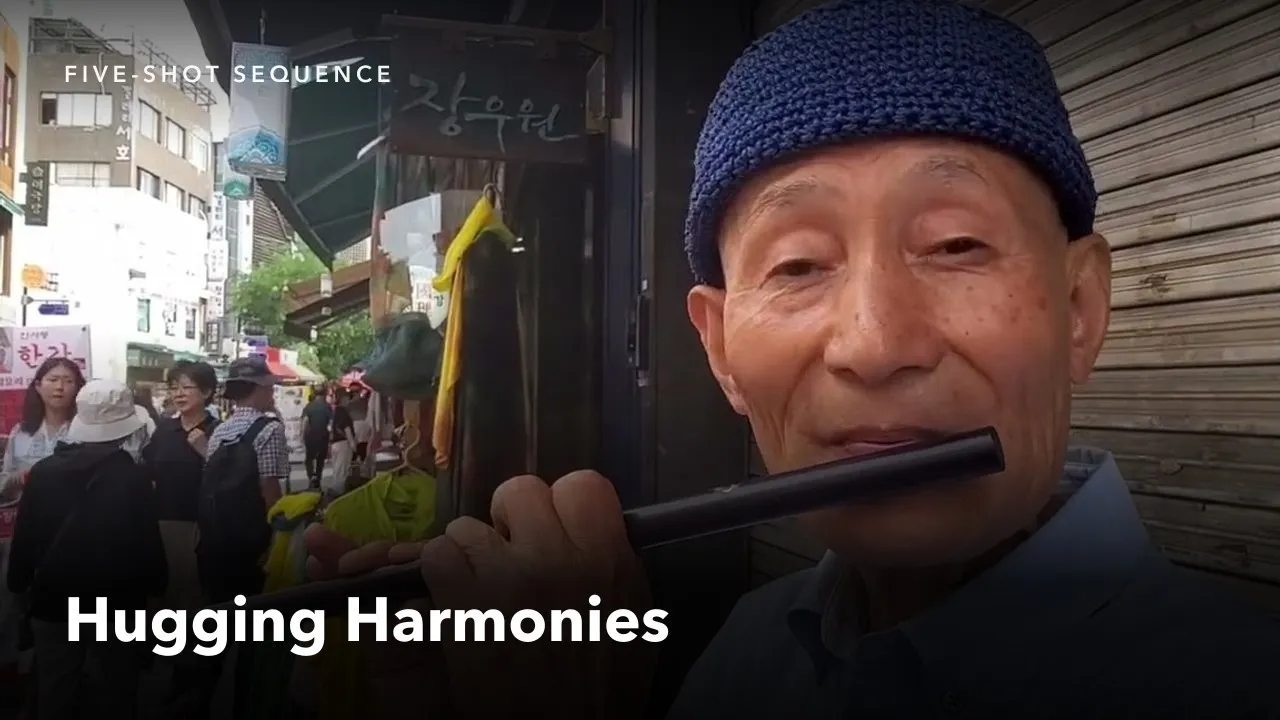
I went to Insadong, Seoul’s historic craft district — a place full of life, even in the middle of the week.
I came across a man playing the flute in the street. I was so fascinated by him that I worked up the courage to ask if I could film him. And not only did he say yes straight away, he also told me about his past as a teacher and his immense love for music.
The assignment was to film someone from five predetermined angles and edit them into a sequence that conveyed an emotion. I tried to capture the sweetness I saw in his eyes.
He told me to stop by and see him every now and then. Who knows, maybe one day…
2. Flawsome
PSA · 52 seconds · watch on YouTube
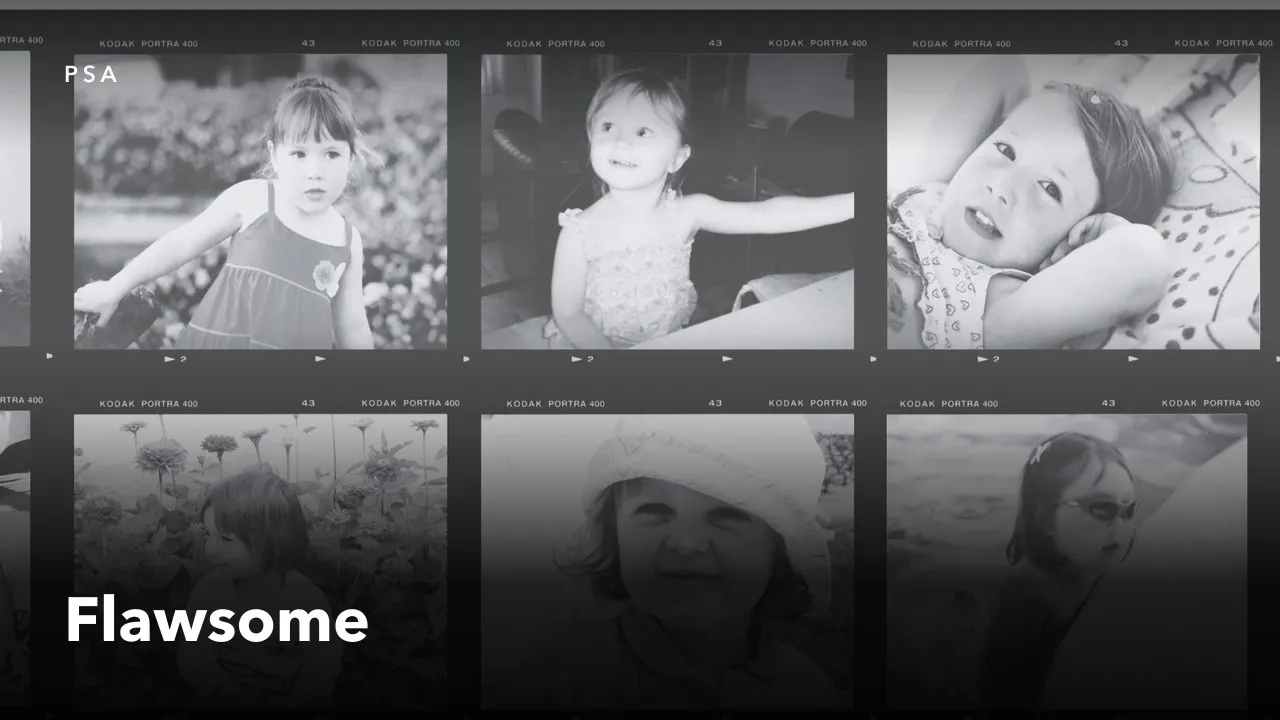
It’s the video I care about most, because of the subject and the people who were part of it.
The title is a play on words: flaws and awesome. Flawed, and wonderful at the same time.
The video asks viewers to think about the little girl they once were — the one who didn’t worry about being perfect and wasn’t afraid to show her true colors — hence the choice of song in the background.
Three statistics appear on screen, each with its source:
- in 2024, 32.5% of Korean girls in middle and high school reported experiencing depressive symptoms1
- low self-esteem predicts depression more than depression predicts low self-esteem — a finding that suggests the former may precede the latter2
- according to the World Health Organization, good mental health does not mean being free of problems, but being able to «cope with the stresses of life, realize their abilities» and contribute to their community3
3. Accidentally Wes Anderson II
News/Event · 2 minutes 25 seconds · watch on YouTube

The third assignment asked us to tell the audience about a fact or event they didn’t know about.
I chose Accidentally Wes Anderson II, a photography exhibition held at Ground Seesaw Central from October 18, 2024 to April 13, 20254 — because I love Wes Anderson’s directing and I love color.
The project grew out of an Instagram profile: photographs submitted from all over the world that look like they came straight out of one of his films — symmetrical façades, pastel colors, signs crooked in just the right way. Obviously, I couldn’t not go.
4. Korea Through Local Lenses
Feature story · 5 minutes 37 seconds · watch on YouTube
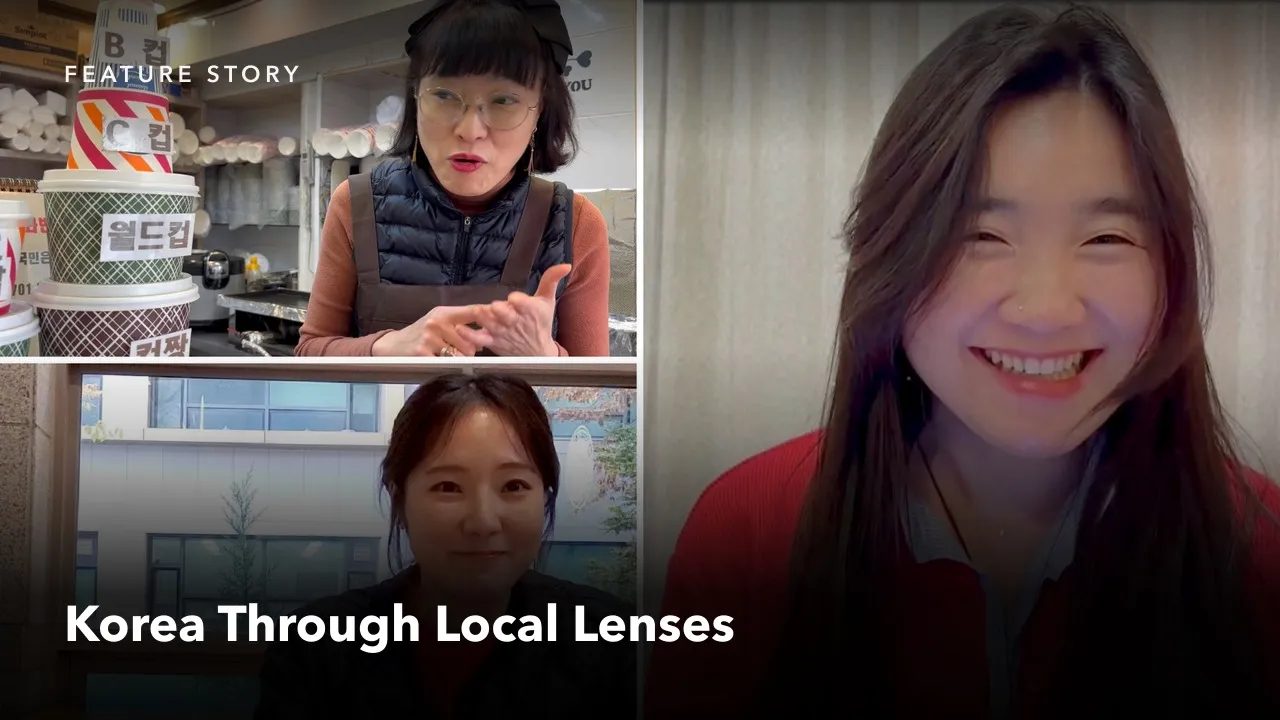
The final assignment took more time than the others and was built around six questions, all about the relationship between people living in Korea and the tourists who fill its streets every year. In 2024, the year I filmed it, there were 16.37 million of them: almost fifty per cent more than the year before.5
Three women I was lucky enough to meet while living there took part: the first runs an artisanal perfume shop in Insadong, the second the café in my dorm, and the third a fried chicken restaurant near the university.
The perfume shop owner had had her store for four years and told me that eighty per cent of her customers are foreigners. She told me about regular customers who come back with little souvenirs for her, and how much she enjoys hearing people say «hello» and «thank you» in Korean: even in just those two words, she says, you can see their respect. For anyone planning to visit Korea, she recommends learning about the country’s history before going to see the palaces — «so you understand that there is a painful history behind them, and how hard they have worked to preserve them».
I met the second woman almost by chance: we would say hello every morning while she opened the café and I headed to class, until one day she stopped me and asked my name. From then on, one coffee led to another conversation. She told me that as the number of tourists grows, so does Korea’s cultural influence, and she told me about the time she taught someone how to use chopsticks and saw the look of surprise on their face.
The third woman told me about a Japanese friend who, after spending six months in Korea, returned to Japan for work and later came back to visit her at the shop.
And she is the one who closes the video, answering the final question but speaking directly to me:
«In the end, you came here to study, right? […] Studying is really important, but… I hope you can really enjoy this country itself. There are so many beautiful places around. […] When you go back home, I think you’ll be left with really meaningful memories.»
The title is from the surface to the soul, which sounds almost like Seoul in English. In the end, that’s exactly what happened: I started out telling the story of a city and ended up getting to know the people who live there.
Footnotes
-
Korea Youth Risk Behavior Survey 2024, Ministry of Education and Korea Disease Control and Prevention Agency, covering around 60,000 students. Girls 32.5%, boys 23.1%. ↩
-
Sowislo, J. F., & Orth, U. (2013). Does low self-esteem predict depression and anxiety? A meta-analysis of longitudinal studies. Psychological Bulletin, 139(1), 213–240 — a meta-analysis of 77 samples and 35,501 people. ↩
-
World Health Organization — Mental health: strengthening our response. ↩
-
The Korea Herald, 17 October 2024. The first Korean edition, three years earlier, drew 250,000 visitors. ↩
-
The Korea Herald, 5 February 2025: 16.37 million foreign visitors to South Korea in 2024, up 48.4% on 2023 and 94% of the 2019 record. ↩